02
Context
Mudflap
Route Optimizer
Truck drivers make high-stakes stop decisions on the fly. They balance fuel cost against time, often calculating routes by hand under pressure. I designed a guidance system that takes the math off their plate.
How might we help drivers plan smarter routes while driving more traffic to partner stops?
Role
Senior Product Designer
Timeline
Feb 2025 – Mar 2025
Skills
UX Research · UX/UI Design · Prototyping · Testing · Project Management

Overview
A diesel-discount app, made smarter.
Mudflap is a diesel-discount app that connects truck drivers and fleet operators with discounted fuel stops. The Route Optimizer extends that value: instead of just finding a cheap stop, it helps drivers plan a whole route that maximizes profit across the trip.
User goals
Minimize fuel and trip costs
Make smarter stop decisions, faster
Reduce the manual mental math on the road
Business goals
Increase usage of the partner-stop network
Strengthen driver loyalty and trust
Boost overall engagement with the app
Key challenges
Genuinely maximize profit and not just surface the cheapest price
Nudge purchasing behavior toward partner stops without feeling pushy
Accommodate wildly different driver constraints and route realities
Research & Ideation
Two early bets.
Before landing on the route-first approach, I explored two concepts. Neither shipped as imagined, but each sharpened the problem.

✳
Rejected
Profit-Lock
A feature that would let drivers lock in a fuel price now and buy with confidence later. The idea tested well, but guaranteeing a rate added real complexity behind the scenes, and it was hard for drivers to trust a number they couldn’t see how we arrived at. I set it aside rather than ship something opaque.

✳
Proof of concept
Load Chooser
A tool to compare multiple loads side by side and pick the most profitable one. I built a working proof-of-concept, but in practice most drivers are already committed to the loads they have, so the comparison added effort without changing many decisions. It pointed me toward the route itself as the real opportunity.
The Process
From journey maps to a lean MVP.
01
Customer journey mapping & brainstorming
I ran collaborative research and documented requirements with the team, mapping the driver’s real decision moments so we designed for the trip, not just the transaction.
02
MVP
Rather than over-build, we shipped a minimal version to get rapid, real feedback, testing directly with drivers at industry conventions to validate the core loop fast.


Iterations of Key Screens
Designing the two screens that carry the experience.

Trip Details screen
The inputs that power every recommendation, designed for clarity, progressive disclosure, and sensible defaults so drivers aren’t overwhelmed.
→
Fuel level
→
Miles per gallon
→
Hours of service
→
Brand restrictions
→
Required amenities
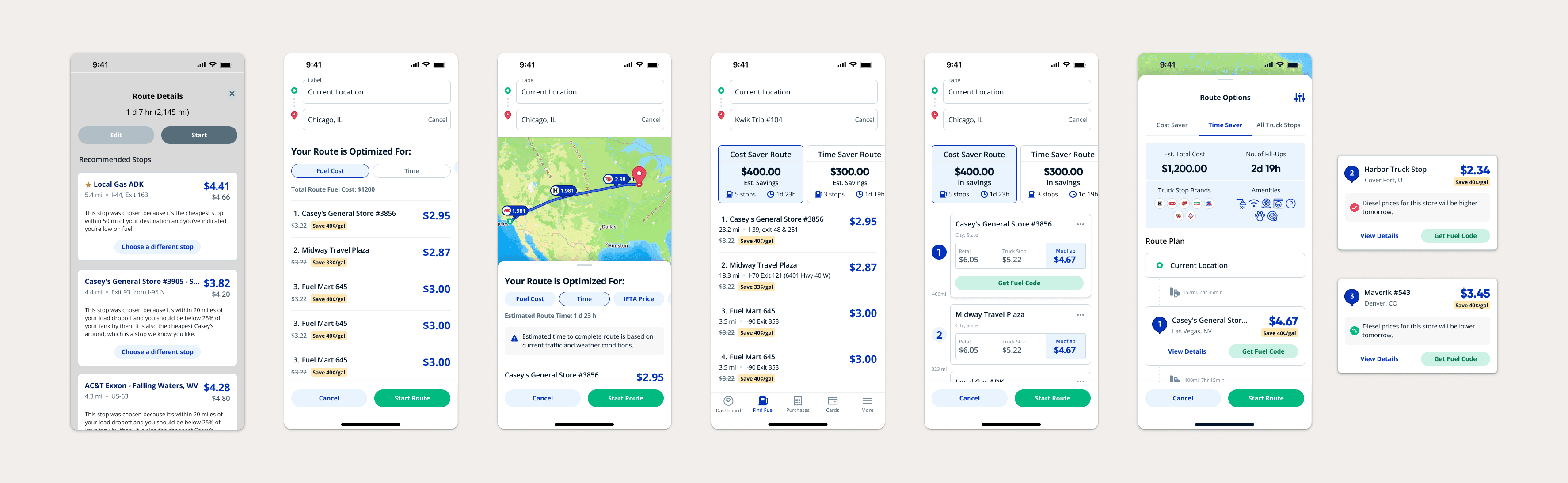
Route Plan screen
The core interface, built to flex to how each driver thinks about a trip.
→
Toggle: Fuel-cost savings vs. time savings
→
Dual map and list views
→
Expandable stop details
→
Mid-flow editing without losing your place
Final Solution
Prototype & flow.
A five-step journey that takes a driver from their truck’s details to a navigable, profit-optimized route.
Step 1
Enter truck details
Step 2
Set trip parameters
Step 3
Forecast price & savings
Step 4
Review the route plan
Step 5
Navigate the route

The Impact
Drivers acted on it and came back.
2 of 3
drivers buy fuel from at least one recommended stop on the same day.
58%
retention beyond 30 days. Drivers kept coming back to plan with it.
Trust
and loyalty rose as the recommendations consistently paid off on the road.
Key Takeaways
What I’d carry forward.
01
Focus on the core scenarios first. Nailing the most common trip mattered far more than handling every edge case up front.
02
Trust is the product. Drivers only adopt a recommendation when it reliably pays off. Credibility is earned stop by stop.
03
Design shapes behavior. Thoughtful defaults and framing nudged real purchasing decisions without ever feeling forced.
Next project
© 2026 Ekekela Novero. All rights reserved.
Designed with care in San Francisco.